Run a decision on a synthetic company. Then ask for one on yours.
Two public views of the same engine. Neither needs a sign-in, a form or a call.

Set the decision, the scope, the pace and the support. See where the load travels.
Marden is a synthetic 270-person company. Choose a restructuring, pin plan A, change one lever for plan B and read the Changeprint: four ranges from 100 engine runs.
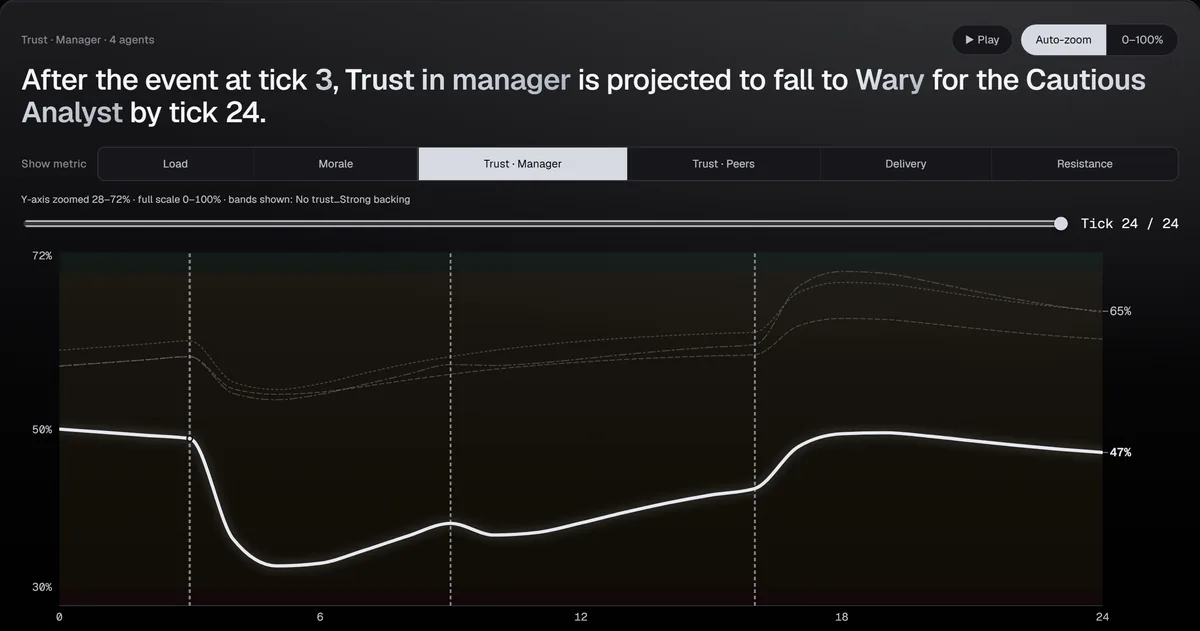
One full run, six signals, week by week.
A replay of one simulated manager change: morale, load, trust and resistance for each role across 24 weeks. Watch only.
Your org chart shows who reports to whom. submove shows what actually moves.
Every point in this sphere is a position, resolved to a masked, role-coded profile and placed by role and seniority. The outer shell is the frontline, the middle layer is management, and the bright core is leadership, each node wired to the people it actually influences.
When a change lands, a new manager, a restructure, a town hall, load, morale and trust do not move in a column on a slide. They travel along these links, person to person, level to level, which is how a change you thought was contained reaches three teams over. The pulses are behavior moving through the network. submove plays it forward and shows you where it settles before you commit.
- Frontline
- Middle management
- Leadership
Six signals, every team, the whole horizon — so you see where the plan needs support first, and sequence the briefings before the announcement.
Built for the decisions that don't get a do-over: a new division head, a return-to-office mandate, a merger integration, the reorg you can only announce once.
Each run resolves into a cockpit: trajectories, the moments they turn, the positions carrying the most load, and a 500-run range — so you see the full spread of outcomes, not a single guess.
Hover or tap a signal to see what it tracks.
Calibrated on 1,102 studies. And we’ll tell you exactly what that does not mean.
“When the board asks how you saw it coming, ‘we ran it forward first’ beats ‘the survey came back in Q3.’”
submove runs on a review discipline modeled on the one medicine uses for drug evidence. Its behavioral assumptions are each traced to published research, extracted under a rule that prefers silence to invention, and every input is audited before it touches a run. The model is calibrated, not validated — and we say so in every deliverable. Most tools claim more and prove less; that line is the discipline you are buying.
Calibrated means every behavioral assumption is traced to published research and stress-tested against it. Validated means tested against your own outcomes — and if you want that proof, we replay a change you already made — at team and role level, never named individuals — and show you how close the model came, run as an engagement. The evidence is strong enough to act on, and the method disciplined enough to trust.
For context, not as our own result: widely-cited industry research finds most large change efforts fall short of their original goals, and that replacing a regretted hire can cost roughly half to twice their salary. In that light, the cost of one avoidable misstep in a major change can outweigh the cost of rehearsing the decision first.
Consulting-led, governed, end to end — in weeks, not a quarter.
submove is a consulting-led diagnostic, not raw engine access: you name one decision, we build the model by hand, run it, and walk you through the cockpit — and you leave seeing where the plan strains and what to sequence first, with masking and governance in every step.
-
Profile the organization, without names
We resolve your people to governed, role-coded profiles inside your real reporting network — no names, no PII, personality a moderator and never the driver. Nothing we will ever use to score, rank, or name a person.
-
Specify the change
We capture the event you are weighing — a new manager, a restructure, an RTO mandate — and the weeks you want to watch it unfold, written up as a precise scenario.
-
Run the simulation
The engine plays it forward tick by tick, 500 rehearsed runs, so load, trust and performance spread across the network as a range of outcomes, not a single guess.
-
Read the cockpit
Six trajectories over time with the inflection points, the positions carrying the most load, and where each signal turns — so you see where the plan needs support first.
-
Debrief with your team
We walk the cockpit together: where the load is absorbed, where trust slips, where the model projects resistance to concentrate and when, and the plan levers to pull first.
-
Decide — and, if you want, prove it
Commit knowing where to intervene. Later, a pilot retrodiction can replay a real recent change at team and role level and compare the model's projections against what actually happened, run as an engagement.
What leaders ask before the first run.
Why is this different from anything on the market?
Every other tool is a postmortem. Engagement surveys and people analytics tell you how your organization felt after a change has landed — when the cost is sunk and the damage is done. submove runs forward: it rehearses how your people are likely to respond before you act, so you can see a morale dip, a trust erosion, or a spike in resistance take shape while it is still a choice. No survey fatigue, no waiting a quarter to find out you were wrong.
How do you model the organization without personality scoring?
We resolve each position to a masked, governed profile, role-coded labels and masked identifiers, placed inside your real reporting network. Personality and Big Five traits sit in a moderators-only layer, they shape how a node reacts, but they are not the driver and we never score or rank an individual. The leverage is masked, position-level resolution plus network dynamics under a defined change, not a personality test.
How does the personalized, org-specific simulation work?
We compose a population that reflects your real teams and reporting structure, the mix of roles, seniority, and behavioral profiles you actually have. Your specific change is then run over that population, not against a generic industry benchmark. The result is a trajectory for your organization, so the numbers speak to the people who will live through the decision.
How reliable is it, and what does it actually claim?
Think of it the way a flight simulator works: it will not predict the exact weather on a given day, but it shows how the system behaves under conditions you choose. submove is directional and calibrated, not validated. Every run is a Monte Carlo simulation that returns ranges rather than single points, and it is explicit about its limits: a decision-support diagnostic, not a forecast of any individual's behavior.
We already use change consultants. Why this?
Use both — they are different instruments. Consultants bring judgment, facilitation and a playbook; submove brings a forward view of how your specific network responds before anyone acts. The best engagements run them together: the simulation points your advisors at where to look first, which group to brief, and where the plan will strain, so their hours go to the decisions that move the outcome. We are consulting-led ourselves; we are built to sharpen a change effort, not replace it.
Is this used for hiring, firing, or ranking people?
No, and we decline engagements that push that way. submove is never sold for hiring, firing, layoff targeting, promotion or compensation ranking, disciplinary decisions, or identifying individuals. It models how a masked, role-coded network responds to a change; it does not score, rank, or name people.
Do my employees take a survey? What data do you need?
No survey, and no personally identifiable information. We do not poll your people or collect names, reviews, or HR records. We resolve your organization to masked, role-coded profiles and shape the model to your structure, so you get foresight without adding a single item to anyone's inbox, and with nothing that could be used to score or identify a person.
What changes can it model?
The kinds of events that move organizations: a new manager or leadership change, a restructure or reorg, a return-to-office mandate, a town hall or major announcement, a merger, a policy shift. If it changes how people experience their work, submove can play it forward and show you the response across your organization over the following weeks.
How do we get a run, and what does the engagement look like?
You bring us the change you are weighing and a picture of the population it affects. We compose the simulation, run it, and walk you through the trajectories, where morale holds, where trust slips, and where the model projects resistance to concentrate and when. It is a focused engagement designed to give you a clear read before you commit, not a long deployment.
What about data and privacy?
Privacy is structural, not a promise we bolt on afterward. Because the model needs no PII and no survey responses, there is no sensitive employee data to store or expose in the first place. Your inputs describe structure and scenario, not individuals, and everything runs inside our standard secure infrastructure.
Does it replace our HR team or our judgment?
No. submove is an instrument, not a decision. It gives change leaders a forward view to stress-test a plan, sequence it better, or prepare the support that specific groups will need. The call is still yours; the simulator just means you make it with foresight instead of hindsight.
Name the decision. See it before you make it.
One decision, one conversation. Tell us the change you are weighing and we will tell you honestly whether a simulation will help — before we ever talk price. We say no when it is not a fit.
- A behavioral model built for your org and the change you name, calibrated on 1,102 studies.
- A walkthrough of the cockpit with your team, where stress holds and where trust slips.
- We reply within two business days. A focused engagement — weeks, not a quarter.